

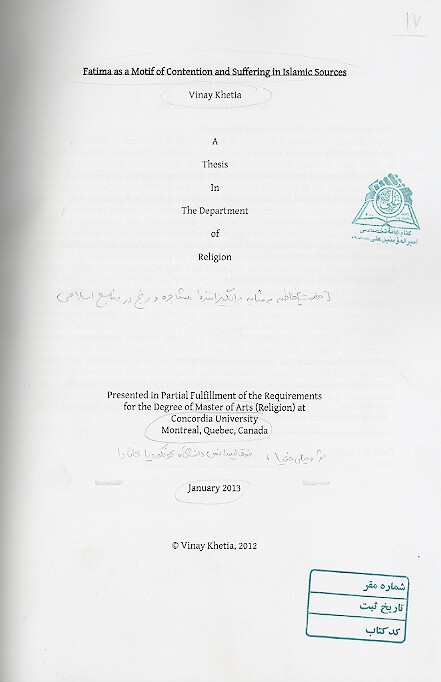
Fatima as a Motif of Contention and Suffering in Islamic Sources
محل نشر: كانادا، مونترآل
ناشر(ان): Concordia University
تاریخ نشر: 2012 م
نوبت چاپ: اول
تعداد صفحات: 101
موضوع(ها): زندگاني
محل در کتابخانه (کد مقر): 018-006-004-020
زبان(ها): انگليسي
نوع مدرک: پایان نامه کارشناسی ارشد
قطع و اندازه: رحلي
نوع جلد: گالينگور
مجموعه ها
:
چکیده: Abstract
The death of the Prophet Muhammad in 10/632 left a vacuum of authority in the early Muslim community. Ever since, Muslims of various sectarian persuasions have produced conflicting versions of the events which took place in the wake of Muhammad’s death and the behaviour of certain prominent personalities. This dissertation examines the role played by the surviving daughter of the Prophet, Fatima, during this early, tumultuous period. The objective is not to present a ‘historical’ reconstruction of events, but rather to explore how the formative Islamic histories (2nd-4th/8th-10th centuries) and Shiite hadith (2nd-6th/8th-12th centuries) creatively shaped the image of Fatima in her conflict with the first caliph and successor to Muhammad, Abu Bakr, and his allies. For Sunnites, Abu Bakr was a wise leader who aimed to safeguard the unity of the Muslim community even if that entailed Fatima’s dissatisfaction. For Shiites, on the other hand, Abu Bakr and Umar (the second caliph and a key advocate of Abu Bakr’s leadership) were usurpers who marginalized and even viciously assaulted the daughter of the Prophet. In the making of both images, gender is at play. For the Shiites, Abu Bakr and above all Umar betray ideals of maleness by bullying a defenceless woman who is portrayed, somewhat against conventional views of the feminine, as sagacious and strong. The Shiite image of Fatima also draws on the idea of women as emotional to make her into a righteous sufferer and mourner on a cosmic scale. In the Sunnite-leaning histories, on the other hand, Fatima conforms to stereotypes of femininity by exhibiting excessive emotion and irrationality, while Abu Bakr plays the role of a wise, indulgent, paternal male. Western scholars have tended to view Fatima as a marginal figure; but an examination of the early sources shows her image to be key to the development of sectarian views and competing Sunnite and Shiite appraisals of the companions of Muhammad.
https://spectrum.library.concordia.ca/id/eprint/976817/
https://spectrum.library.concordia.ca/976817/1/Khetia_MA_S2013.pdf
| contributor author | khetia, Vinay | |
| date accessioned | 2023-06-04T18:01:38Z | |
| date available | 2023-06-04T18:01:38Z | |
| date copyright | 2012 م | |
| identifier uri | http://hdl.handle.net/110/12532 | |
| description abstract | Abstract The death of the Prophet Muhammad in 10/632 left a vacuum of authority in the early Muslim community. Ever since, Muslims of various sectarian persuasions have produced conflicting versions of the events which took place in the wake of Muhammad’s death and the behaviour of certain prominent personalities. This dissertation examines the role played by the surviving daughter of the Prophet, Fatima, during this early, tumultuous period. The objective is not to present a ‘historical’ reconstruction of events, but rather to explore how the formative Islamic histories (2nd-4th/8th-10th centuries) and Shiite hadith (2nd-6th/8th-12th centuries) creatively shaped the image of Fatima in her conflict with the first caliph and successor to Muhammad, Abu Bakr, and his allies. For Sunnites, Abu Bakr was a wise leader who aimed to safeguard the unity of the Muslim community even if that entailed Fatima’s dissatisfaction. For Shiites, on the other hand, Abu Bakr and Umar (the second caliph and a key advocate of Abu Bakr’s leadership) were usurpers who marginalized and even viciously assaulted the daughter of the Prophet. In the making of both images, gender is at play. For the Shiites, Abu Bakr and above all Umar betray ideals of maleness by bullying a defenceless woman who is portrayed, somewhat against conventional views of the feminine, as sagacious and strong. The Shiite image of Fatima also draws on the idea of women as emotional to make her into a righteous sufferer and mourner on a cosmic scale. In the Sunnite-leaning histories, on the other hand, Fatima conforms to stereotypes of femininity by exhibiting excessive emotion and irrationality, while Abu Bakr plays the role of a wise, indulgent, paternal male. Western scholars have tended to view Fatima as a marginal figure; but an examination of the early sources shows her image to be key to the development of sectarian views and competing Sunnite and Shiite appraisals of the companions of Muhammad. https://spectrum.library.concordia.ca/id/eprint/976817/ https://spectrum.library.concordia.ca/976817/1/Khetia_MA_S2013.pdf | ٍُُEn |
| format extent | رحلي | |
| format medium | گالينگور | |
| language | انگليسي | |
| publisher | Concordia University | |
| subject | زندگاني | |
| title | Fatima as a Motif of Contention and Suffering in Islamic Sources | |
| type | پایان نامه کارشناسی ارشد | |
| identifier libid | 32220 | |
| publisher place | كانادا، مونترآل | |
| publisher country | كانادا | |
| book edition | اول | |
| contributor authorrecord | khetia, Vinay-مؤلف(نامعلوم-نامعلوم) | |
| subject category | امیرالمومنین علی علیه السلام | |
| contenttype | قفسه | |
| pages | 101 | |
| identifier shelf | 018-006-004-020 | |
| description note | [حضرت] فاطمه به مثابه برانگيزاننده مشاجره و رنج در منابع اسلامي | |
| date issuedmiladi | 2012 م |